Templates
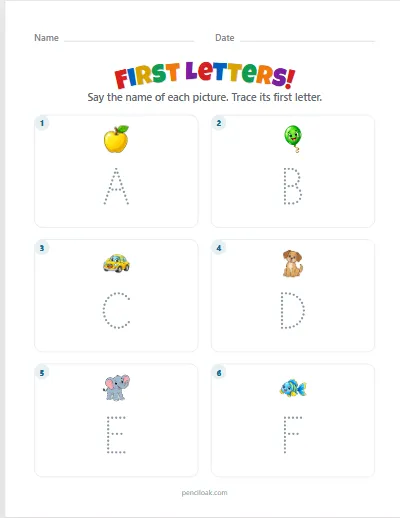
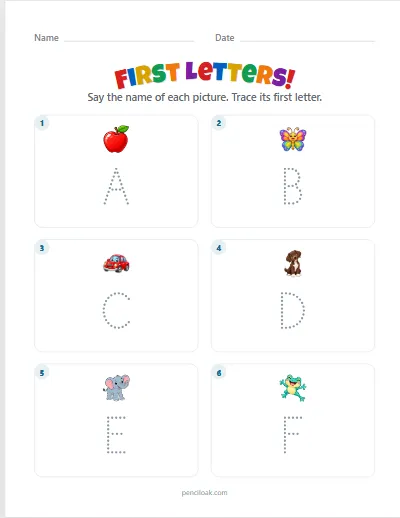
Before children read words, they learn that words are made of sounds, and that the first sound of a word is the easiest one to hear. Say "apple" slowly and the opening sound stands out on its own. Matching that sound to the letter that writes it, with a hand that already knows how to shape it, is one of the first bridges between talking and reading — and it is what these worksheets practice.
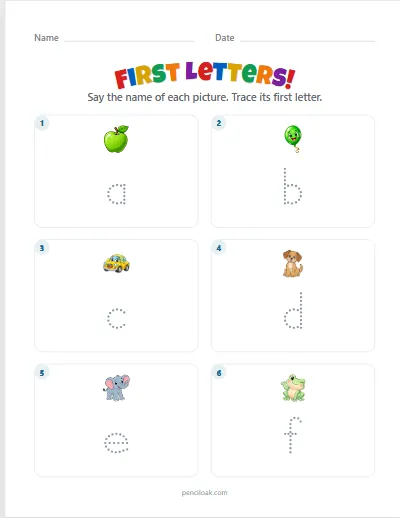
Every box shows one picture and, underneath it, that picture's first letter drawn as a dashed outline. The child says the picture's name out loud, listens for its first sound, and traces the letter along the dashes. There is nothing to read or guess: the letter to trace is right there on the page, so a child who does not read yet can still do the whole sheet once an adult has named the task.
Capital letters are usually learned first: they are bigger, made of straight lines and simple curves, and they are the ones children see on signs and in their own names. Lowercase letters come right after and are the ones that fill almost every page of a book. Switch "Case" above to make a sheet of either kind, or change a single question to mix them on one page.
Right now the pictures cover the letters A, B, C, D, E, F, G, H, I, J, K, L, M, N, O, P, Q, R, S, T, U, V, W, X, Y and Z; more letters are added as new pictures are drawn. "All letters" uses every picture we have, and a narrower group keeps the sheet to a smaller part of the alphabet. Press New sheet until the page looks right, lock the questions you want to keep, and print. Nothing to sign up for.
One letter at a time, A to Z
A sheet for every letter: trace the capital and the lowercase, then circle the pictures that start with it.
12 ready-to-print sheets
- First letters · Capitals · 6 questions
- First letters · Capitals · 9 questions
- First letters · Capitals · 12 questions
- First letters · Lowercase · 6 questions
- First letters · Lowercase · 9 questions
- First letters · Lowercase · 12 questions
- First letters A–F · Capitals · 6 questions
- First letters A–F · Capitals · 9 questions
- First letters A–F · Capitals · 12 questions
- First letters A–F · Lowercase · 6 questions
- First letters A–F · Lowercase · 9 questions
- First letters A–F · Lowercase · 12 questions
 Free PDF packGet 12 ready sheets as one PDFFirst letters: Say the picture, trace its first letter. Capital or lowercase. 13 pages, US Letter or A4.Open the pack →