
How to teach letters and first sounds
Learning letters means learning two things that belong together: what a letter looks like, and what sound it stands for. A child also has to hear the sounds inside a spoken word before those sounds can be matched to letters. All of that comes more easily in small pieces, so this guide goes one step at a time.
Plan on a few minutes a day. You can stay on any step for as long as the child needs, and you can go back a step when something new falls apart. That is a normal part of learning letters, not a sign that you have done something wrong.
This is a general routine, not an assessment. If you are worried about how a child is learning, talk to their teacher or doctor.
Before you start
- Know the difference between a letter's name ("bee") and its sound (the first sound in "ball"). Children learn both, and they get mixed up often.
- Have the child's own name written on a card. It is the most interesting word they know.
- Magnetic or paper letters are nice to have but not required. A pencil, a sheet of paper and a few minutes are enough.
Step 1: Begin with the letters in their name
Children care most about the letters they see most. Show the name on a card, point to each letter, say its name and let the child trace it with a finger. Then look for the same letters on cereal boxes, signs and books. When the child is ready to hold a pencil, name tracing gives them their own name to trace, row after row.
Step 2: Match capitals and lowercase
Every letter has two shapes, and the child has to learn that "A" and "a" are the same letter. Some pairs look alike (C and c, S and s, O and o) and some do not (A and a, G and g, R and r). Start with the pairs that look alike and add the others a few at a time. Draw lines between matching pairs, or match magnetic letters on the fridge.
Step 3: Teach the sounds, a few letters at a time
Pick three or four letters, say each sound while the child looks at the letter, and use them for a few days before adding more. Choose letters that look and sound different from each other. Teaching b, d, p and q in the same week invites mix-ups, because they are all made of the same round-and-stick shape.
Keep each sound short and clean. For the letter m, many teachers say a held "mmm" rather than "muh", because the child will later need to blend sounds into words.
Step 4: Hear the first sound of a word
Before a child can match a first sound to a letter, they have to hear it. Play listening games with no letters at all: "What is the first sound in sun? /s/." "I spy something that starts with /m/." Let the child sort toys into two piles by their first sound. Stick to words where the first sound is clear. Words like "knee" or "phone", where the spelling does not match the sound, can wait.
When listening is easy, put the sound together with the letter: the child says the picture, hears the first sound and traces the letter that makes it.
Step 5: Listen for the last sound
The last sound is harder to hear than the first. Ask the same way: "What do you hear at the end of cat? /t/." Do this once first sounds are secure, with short words such as cat, sun, dog and fish.
Step 6: Put the alphabet in order
Singing the alphabet song does not mean a child knows the letters in order. Point to the letters while you sing, then try rows of the alphabet with a letter missing, like A B _ D E. Do this last: order matters less than recognizing letters and sounds.
When it goes wrong
- Mixes up b, d, p and q. This is very common. Leave the four apart for a while, then give them one at a time. A search that asks the child to color every b among look-alike letters is good practice.
- Sings the song but cannot name the letters. Point to each letter as you sing, and practice letters out of order.
- Gives the letter's name when you ask for its sound. Say the sound for them, ask again, and keep the two ideas apart: "This is the letter B. It says /b/."
- Forgets yesterday's letters. Two minutes of review at the start of each session works better than new letters every day.
- Loses interest. Use their favorites: the letter d for a dinosaur fan, the letter c for the cat.
Letter practice without a worksheet
- Find the first letter of the child's name on signs, packages and books.
- Write letters with a finger in a tray of sand, flour or salt.
- Play "I spy" with first sounds in the car or at the table.
- Sort toys, or things in the kitchen, by their first sound.
- Read an alphabet book and let the child name the picture on each page before you read the word.
When to move on
You can move to reading words, starting with sight words, when the child can:
- name or sound most of the letters, capital and lowercase;
- match each capital to its lowercase;
- say the first sound of a simple word;
- say the last sound of a short word, with a little help.
Free worksheets for each step
Each tool makes a new sheet whenever you press New sheet. Every sheet has an answer key for the grown-up and prints in color or black and white. For step 6, ABC order has rows of the alphabet with letters to fill in.
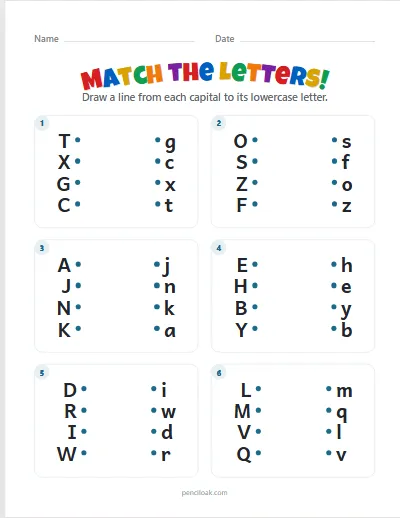
Step 2. Draw a line from each capital letter to its lowercase letter.
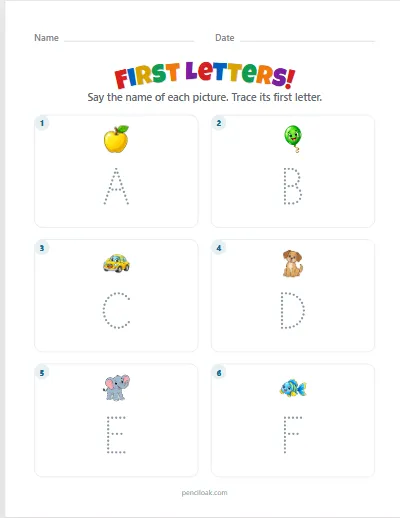
Step 4. Say the picture and trace its first letter. Capitals or lowercase.
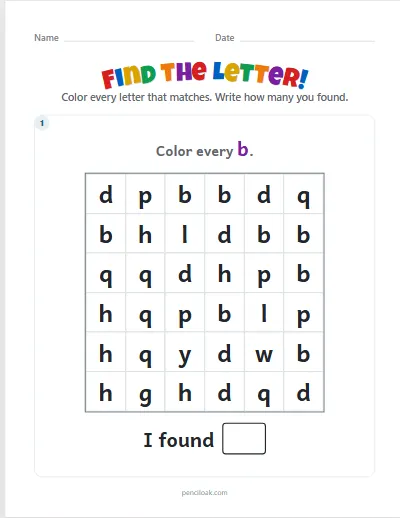
For b, d, p and q mix-ups. Color every b in a grid of look-alike letters.
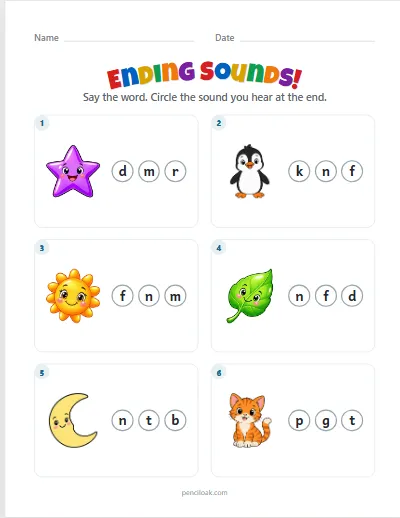
Step 5. Say the picture and circle the letter for the sound at the end.
You can also browse all worksheets, or read the guide on teaching counting to 10.
Read next
- Rhymes and syllablesClap the parts of a word, hear a rhyme, make one, then meet word families and the last sound — all listening games first.
- How to teach sight wordsThree to five words at a time: look, say, trace, find the word in print and read it in a sentence — and what to do when a child guesses from the first letter.
- Addition and subtraction with picturesFrom real objects to pictures, the number line and dominoes: adding, taking away and, last of all, writing the sum.