
Addition and subtraction with pictures
Adding and subtracting grow out of counting. A child who can count a small group and say how many there are is ready to ask the next question: what happens when I put more with them, or take some away? Children understand this long before they can write "2 + 3 = 5", so this guide starts with real things, moves to pictures and the number line, and leaves the written sums for last.
Take it slowly and keep the numbers small, up to 5 first and then up to 10. Five or ten minutes is enough, and you can stay on one step as long as the child needs.
This is a general routine, not an assessment. If you are worried about how a child is learning, talk to their teacher.
Before you start
- The child should be able to count a group of up to 10 and say how many there are. If not, begin with the guide on teaching counting to 10.
- Have small objects to move: blocks, buttons, toy cars, snacks.
- Use the same words every time: "and", "plus", "altogether" for adding; "take away" and "left" for subtracting.
Step 1: Act it out with real things
Put two blocks on the table. Add three more and ask, "How many altogether?" Let the child count them all. Then take two away and ask, "How many are left?" Tell small stories as you do it: "Two cars were parked. Three more drove in." Do this for several days before using pictures or numbers. It is the most important step.
Step 2: Add with pictures
Pictures stand in for objects. Show two groups of pictures and ask how many there are altogether. The child counts them all, from the beginning, and that is the right way to start. Keep the sums to 5 until the counting is easy and only then go up to 10.
Step 3: Count on and use the number line
After a while a child can stop counting both groups from one. Instead they start at the bigger number and count on: "Four. Five, six, seven." A number line makes this visible. The child starts at a number and hops forward one step for each thing they are adding. The line shows that adding means moving further along, and it prepares the ground for bigger numbers.
Step 4: See the parts in dominoes
A domino has two halves with dots. Counting the dots on each half and then putting them together shows addition as two parts that make a whole. It also teaches the child to see small amounts at a glance, without counting each dot.
Step 5: Subtract by crossing out
Take away is easiest to see when pictures are crossed out. Show a group of pictures, cross some of them out, and ask, "How many are left?" The child counts the ones that are not crossed out. Use the same kind of story you used with real objects: "Five apples. We ate two. Three are left." Later, the number line works for subtracting too, hopping back instead of forward.
Step 6: Write the sum
Only when the child can add and subtract with pictures, show how it looks in numbers: 2 + 3 = 5 and 5 − 2 = 3. Explain the signs in words. The plus sign says "and", the minus sign says "take away", and the equals sign says "is the same as". Read every sum aloud, in words. If writing digits is hard for them, let them point to the number cards.
When it goes wrong
- Counts everything again every time. That is fine at first. When it feels too slow, show counting on from the bigger number with the number line.
- Mixes up plus and minus. Say the sign in words each time, and read the whole sum aloud before solving it. Practice one kind of sum for a while before mixing them.
- Gets the wrong answer by counting the crossed-out ones. Ask: "How many are left?" and point to the ones that are still there.
- Struggles above 5. Stay with sums to 5 longer, then add one number at a time. Dominoes and ten frames help the child see amounts.
- Loses interest. Use things they love for the stories, and stop before they are tired.
Practice without a worksheet
- Tell number stories at snack time: "You have 3 crackers and I give you 2 more."
- Play with two dice and add the dots.
- Build a tower of blocks, add some, take some away, and count what is left.
- Hop along a number line drawn in chalk on the pavement, or taped on the floor.
- Ask small questions through the day: "There are 4 of us and we need 6 chairs. How many more?"
When to move on
You can start on bigger sums and on number bonds when the child can:
- add two small groups of objects or pictures and say the total, without help;
- take some away and say how many are left;
- hop forward and back on a number line;
- read and say a written sum such as 2 + 3 = 5 in words.
Free worksheets for each step
Each tool makes a new sheet whenever you press New sheet, and you can choose how high to count. Every sheet has an answer key for the grown-up and prints in color or black and white. Later, number bonds show how a number splits into two parts.
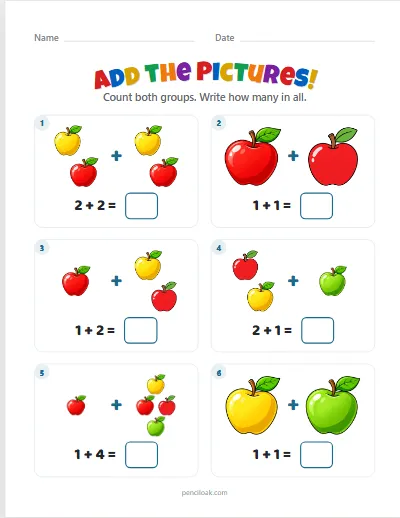
Step 2. Add two groups of pictures and write the sum. To 5 or 10.
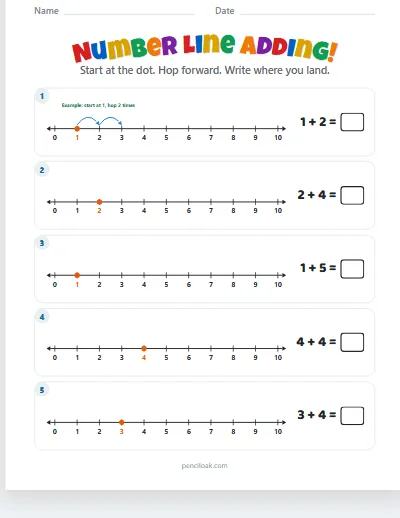
Step 3. Start at the dot and hop forward on a number line.
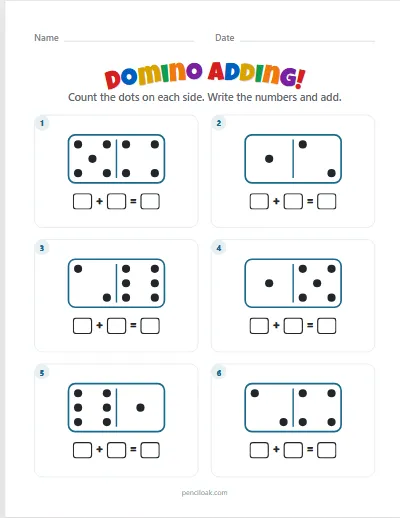
Step 4. Count the dots on each half of a domino and add them.
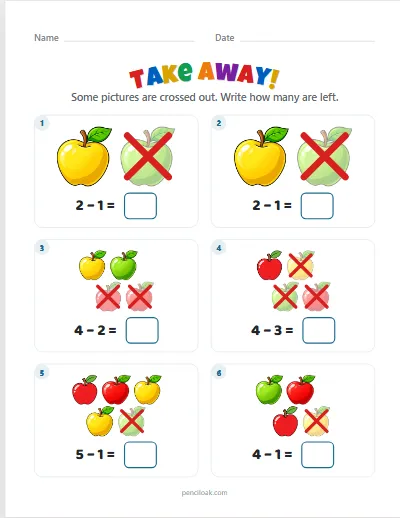
Step 5. Some pictures are crossed out: write how many are left.
The subtraction number line hops back instead of forward. You can also browse all worksheets.
Read next
- Ten frames, tens and onesFill the ten frame, make ten, see a teen number as ten and some more, then count by tens and find your way on the hundred chart.
- How to teach counting to 10Say the numbers, touch each thing once, know the last number says how many — one small step at a time, with free printable practice.
- Patterns, sorting and logic puzzlesSort, find the odd one out, continue a pattern, color the other half and solve a first sudoku — and why "how do you know?" matters most.