
Patterns, sorting and logic puzzles
Patterns, sorting and logic puzzles ask a child to do something that sits underneath all of math: notice what is the same, notice what is different, and use that to decide what comes next. None of it needs numbers, which is why it is a good place to build confidence. This guide goes from sorting objects to patterns, from there to symmetry, and ends with a small sudoku with pictures.
Each step takes five or ten minutes. Start with real objects and talk a lot: the most important part is the child explaining why.
This is a general routine, not an assessment. If you are worried about how a child is learning, talk to their teacher.
Before you start
- Collect objects that differ in color, shape and size: buttons, blocks, socks, pasta, leaves.
- Have a few small bowls or sheets of paper to sort into.
- Ask "How do you know?" often. It matters more than the right answer.
Step 1: Sort by one thing
Put a mixed pile on the table and ask the child to make groups. Let them choose the rule, then ask what it is: "These are all red." Next, give the rule yourself: sort by color, then by shape, then by size. After sorting, count each group and say which has the most. The sheets ask the child to do exactly this with shapes.
Step 2: Find the odd one out
Line up four things where three are the same and one is different, and ask which one does not belong. Ask why. The answer is not always the one you expected. If the child has a good reason, that is a good answer. Later, try rows where the odd one is the same picture turned around, which is much harder to spot.
Step 3: Make and continue patterns
A pattern repeats. Start with two things, red and blue, red and blue (an AB pattern). Say it aloud as a rhythm: "red, blue, red, blue." Ask what comes next. Then try AAB (red, red, blue), ABB, and ABC (red, blue, green). Make patterns with sounds and movements too: clap, stomp, clap, stomp. If the child can copy a pattern but cannot continue it, ask them to say it out loud, because the rhythm tells them what comes next.
Step 4: Put things in order by size
Take three or more objects of the same kind in different sizes and ask the child to line them up from smallest to biggest. Then reverse it: from biggest to smallest. Words such as "bigger", "smallest" and "in the middle" come up naturally here.
Step 5: Try symmetry
Fold a piece of paper in half, paint on one side, press it closed and open it to see the same picture on both sides. On a grid, the idea becomes a puzzle: half of a picture is colored in, and the child colors the other half so that the two sides match like a mirror. Start with a small picture and a short grid. Symmetry sheets do this with pictures from the catalog.
Step 6: A sudoku with pictures
A picture sudoku is a small grid, four by four, where each picture appears exactly once in every row, every column and every box. Explain the rule with the first puzzle and let the child place one picture at a time. Begin with a grid that has most of its pictures filled in. If the child is stuck, ask: "Which pictures are already in this row?"
When it goes wrong
- Changes the rule in the middle of sorting. Say the rule aloud before they start: "Only red ones in this bowl."
- Copies a pattern but cannot say what comes next. Say the pattern as a rhythm and clap along.
- Picks an odd one out for a different reason. Ask why. If the reason is sound, accept it and ask for another way.
- Gets frustrated with sudoku. Go back to a grid with more pictures filled in, and look at one row at a time.
- Guesses quickly. Slow down and ask the child to tell you how they know before they mark the answer.
Practice without a worksheet
- Sort the laundry: socks with socks, shirts with shirts, big with small.
- String beads or pasta in a pattern for a necklace.
- Make clap and stomp patterns, and let the child lead.
- Look for patterns in the world: tiles on the floor, fence posts, stripes on a shirt.
- Play "Which one does not belong?" with four items on the table.
When to move on
The child is ready for harder puzzles when they can:
- sort a pile by color, by shape and by size, and say the rule;
- find the odd one out and explain why;
- continue an AB, AAB or ABC pattern;
- put three or four things in order by size;
- finish an easy picture sudoku with a little help.
Free worksheets for each step
Each tool makes a new sheet whenever you press New sheet. Every sheet has an answer key for the grown-up and prints in color or black and white.
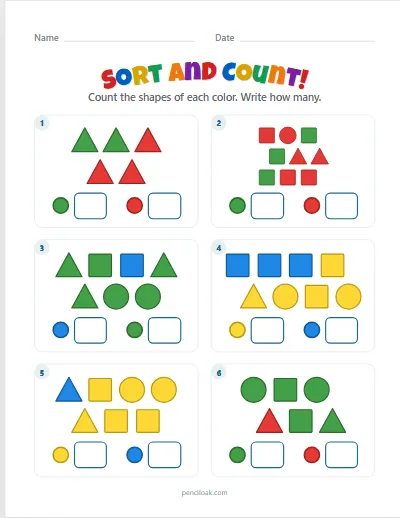
Step 1. Sort shapes by color, shape or size, then count each group.
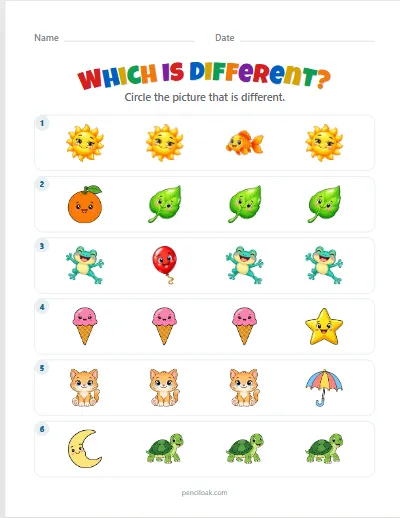
Step 2. Four pictures in a row, one is different: circle it.
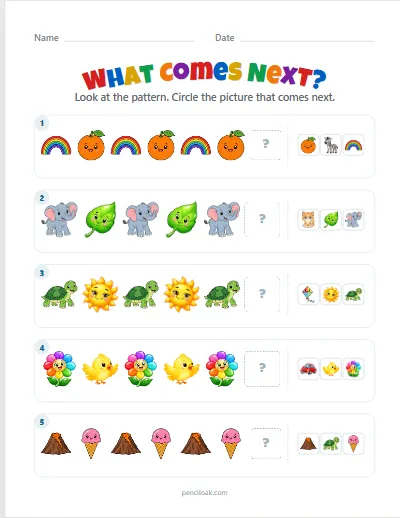
Step 3. Look at the pattern and circle the picture that comes next.
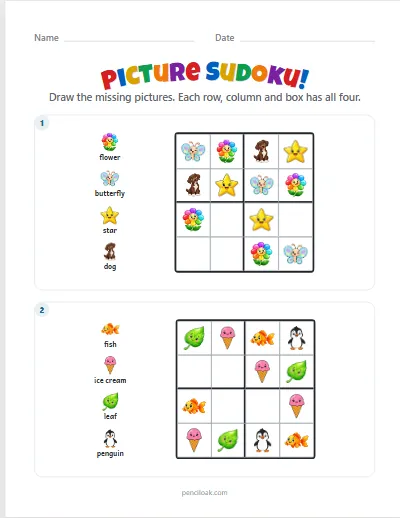
Step 6. A 4 by 4 sudoku with pictures: every row, column and box has all four.
You can also try small to big for ordering by size, or browse all worksheets.
Read next
- How to teach counting to 10Say the numbers, touch each thing once, know the last number says how many — one small step at a time, with free printable practice.
- Addition and subtraction with picturesFrom real objects to pictures, the number line and dominoes: adding, taking away and, last of all, writing the sum.
- Ten frames, tens and onesFill the ten frame, make ten, see a teen number as ten and some more, then count by tens and find your way on the hundred chart.