
Ten frames, tens and ones
Numbers get easier when a child can see them as groups instead of counting every single thing. Ten frames, tens and ones, skip counting and the hundred chart all do the same job: they show that numbers are built out of fives and tens. This guide takes them in the order that works for most children, starting with the smallest picture, a box of ten squares.
Each step takes five or ten minutes, and you can stay on one for as long as the child needs. Use real objects first and paper after that.
This is a general routine, not an assessment. If you are worried about how a child is learning, talk to their teacher.
Before you start
- The child should count to 10 with confidence and be able to count out a number of objects. If not, begin with the guide on teaching counting to 10.
- Have about twenty small counters: buttons, coins from a game, pasta shapes, in two colors if you can.
- Draw a ten frame on paper: a box with two rows of five squares.
Step 1: Fill the ten frame
Put counters in the frame one at a time, filling the top row first, left to right, and then the bottom row. Show three, then seven, then ten. For seven the child sees a full row of five and two more. Ask, "How many empty squares are there?" and the answer, three, tells them how far seven is from ten.
Next, flash a frame for two seconds and cover it. Ask how many there were. A child who can say "seven" without counting every counter has started to see numbers as shapes, which is exactly the point.
Step 2: Make ten
Fill the frame with six counters of one color. Ask, "How many more to make ten?" and let the child add counters of the second color until the frame is full. They now have six and four. Do this with every number from 1 to 9. Pairs of numbers that make ten are some of the most useful facts a child can know, and the frame lets them see why. When the pairs feel familiar, number bonds practice the same idea on paper.
Step 3: Teen numbers are ten and some more
The teen words are tricky because they say the ones first: in "fourteen" the four comes before the ten. Show it with a full ten frame and four counters beside it: ten and four more is fourteen. Later, replace the frame with a rod of ten blocks and four single blocks, then let the child write what they see. The tens and ones sheets do exactly this.
Step 4: Count by tens, fives and twos
Skip counting is counting in groups. Start with tens, because the pattern is the easiest to hear: ten, twenty, thirty. Put ten counters in each pile and count the piles. Then fives, using the fingers of one hand, and then twos, with pairs of socks, shoes or mittens. Say the numbers aloud together until the child can carry on alone.
Step 5: Use the hundred chart
A hundred chart is a grid of the numbers 1 to 100 in ten rows of ten. Each row is one ten, and counting by tens goes straight down a column. Begin with a chart that has most of its numbers filled in, and let the child find a number like 36 by looking for the row that starts with 31. Then take numbers away, a few at a time, and ask the child to fill them in.
When it goes wrong
- Counts every dot again, even in a full row. Keep flashing the frame for two seconds, and teach "a full row is five" as a fact.
- Mixes up 13 and 31. This is very common. Build both with rods and blocks side by side: one ten and three, then three tens and one.
- Skips or repeats numbers when counting by tens. Say it with a drumbeat and put a pile of ten counters under each number.
- Gets lost on the hundred chart. Cover all of the chart but one row and read it, then uncover a row at a time.
- Loses interest. Keep it short, change the objects, and stop while it is still fun.
Practice without a worksheet
- Cut an egg carton down to ten cups and use it as a ten frame, with a small toy in each cup.
- Bundle ten sticks or straws with a rubber band and count the bundles and the loose ones.
- Count the stairs by twos, or the steps along a path by tens.
- Match socks and count the pairs by twos.
- Draw a hundred chart in chalk on the pavement and hop to the numbers you call out.
When to move on
You can start on bigger sums and place value when the child can:
- say how many dots are in a ten frame without counting each one;
- tell you how many more make ten, for any number from 1 to 9;
- build and write a teen number from a ten and some ones;
- count to 100 by tens and by fives, and carry on from a number you give them.
Free worksheets for each step
Each tool makes a new sheet whenever you press New sheet, and you can choose how high to count. Every sheet has an answer key for the grown-up and prints in color or black and white.
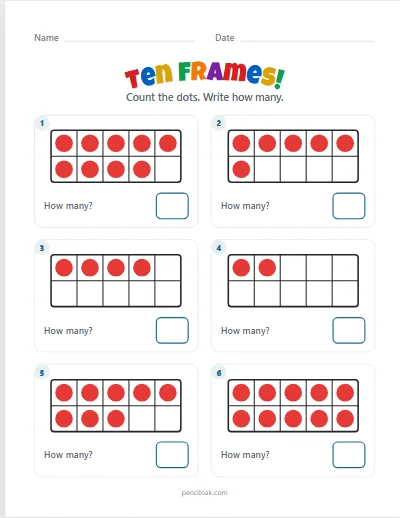
Steps 1 and 2. Count the dots in a ten frame, or draw dots to show a number.
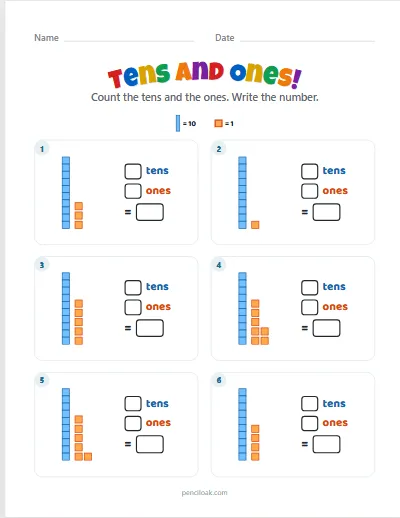
Step 3. Count the rods of ten and the single cubes, then write the number.
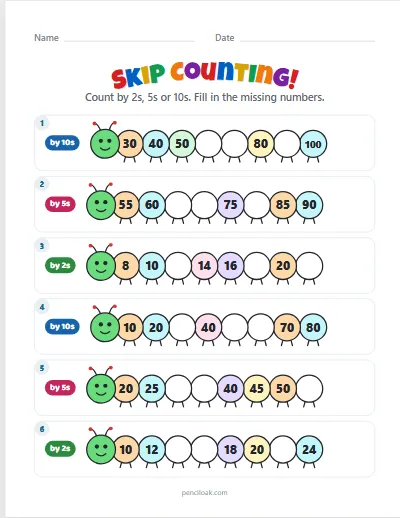
Step 4. Count by 2s, 5s or 10s along a caterpillar and write the missing numbers.
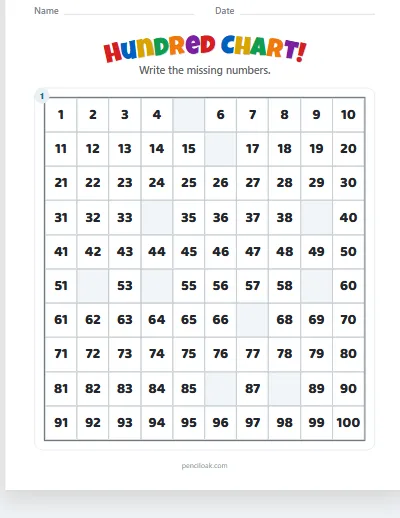
Step 5. Fill in the missing numbers on a chart of 1 to 100.
Ready for the next step? Try adding and subtracting with pictures or browse all worksheets.
Read next
- How to teach counting to 10Say the numbers, touch each thing once, know the last number says how many — one small step at a time, with free printable practice.
- Addition and subtraction with picturesFrom real objects to pictures, the number line and dominoes: adding, taking away and, last of all, writing the sum.
- Patterns, sorting and logic puzzlesSort, find the odd one out, continue a pattern, color the other half and solve a first sudoku — and why "how do you know?" matters most.