
How to teach counting to 10
Counting looks like one skill, but a child has to learn three things at once: say the number words in order, say one word for each thing, and understand that the last word tells how many there are. Most children get the first part first. The other two take longer, and mixing them up is where counting usually goes wrong.
This guide teaches the parts one at a time, in an order that works at home and in a classroom. Each step takes five or ten minutes, and you can stay on one step for a week or two if you need to.
This is a general routine, not an assessment. If you are worried about how a child is developing, talk to their teacher or doctor.
Before you start
You do not need worksheets to begin, and you do not need to wait for a certain age. You need:
- A handful of small things that do not roll away: blocks, buttons, crackers, pasta shapes.
- Five to ten minutes when the child is not tired or hungry. Short and often works better than one long session.
- The same words every time: "one, two, three" and the question "How many?"
Start with counting to 5. Add 6 to 10 once 1 to 5 is steady.
Step 1: Say the numbers in order
Before a child can count things, the number words have to come out in the right order. Sing counting songs, count the stairs as you climb them, count your steps to the door, count down "three, two, one, go!" before a game. Do not worry about objects yet.
You are ready for step 2 when the child says 1 to 10 in order without skipping or repeating a number. If they get stuck in the same place every time, practice just that spot — "seven, eight, nine" — and then say the whole row again.
Step 2: One word for each thing
Put five small objects in a line. Ask the child to touch each one once while saying one number word. Teachers call this one-to-one counting: one touch, one word. Let the child move each object into a "counted" pile, or cross it off with a pencil, so that nothing is counted twice and nothing is missed.
The usual slips:
- The words run ahead of the fingers: the child says "one, two, three, four" while touching only two things. Slow down and say the word as the finger lands.
- An object is skipped or counted twice. Go back to a straight line and a counted pile.
- The child stops at a number they like. Count along with them to the end of the row.
A line is the easiest layout to count. A circle is harder because there is no starting point, and things scattered over a table or a page are the hardest, because the child has to make up a path. Move to scattered objects only when lines are easy. On paper, a scene full of pictures that the child crosses off one by one is good practice for exactly this.
Step 3: The last number tells how many
Many children can count five blocks perfectly and then, asked "How many blocks?", start counting again. They have not yet seen that the last number they said is the answer. Teachers call this knowing how many.
Show it: count together, then pause on the last block and say the whole thing — "one, two, three, four. Four blocks. There are four." Ask "How many?" straight after counting and wait. If the child recounts, do not correct them; just say the answer together and try again with a different group. It can take many tries over many days, and that is normal.
Step 4: Count out a number
"Give me four blocks" is harder than "How many blocks are there?" The child has to count and stop in the right place. Try it with real things first: put three crackers on the plate, fetch five spoons. Then try it on paper, where the child reads a number and colors exactly that many pictures and leaves the rest white.
From 6 to 10, a ten frame helps. It is a box of ten squares in two rows of five, so six is "a full row and one more" and the child can see the amount instead of counting every dot again.
Step 5: Connect counting to written numbers
When counting is steady, point to a written number and ask the child to show you that many fingers or blocks, then do it the other way around. Tracing and writing the numbers 1 to 10 comes after that, not before. Many children write some numbers backwards at first. Show the correct way once, calmly, and keep the practice short.
When it goes wrong
- The number words come out in the wrong order. Go back to step 1 and use songs and stairs.
- Counts to 5 easily, struggles with 6 to 10. Stay with 1 to 5 a while longer, then add one number at a time. Ten frames help.
- Recounts when asked "How many?" Practice step 3: say the last number again as the answer, together.
- Loses interest. Make it shorter, make it a game, or count something they love: toy cars, dinosaurs, snacks.
Counting without a worksheet
- Count stairs, steps and jumps.
- Set the table: one plate, one cup and one spoon for each person.
- Count red cars, dogs or birds on a walk. Stop at five or ten and start again.
- Sort socks, shoes or toys and count each pile.
- Count snacks out loud before eating them.
- Roll a die and take that many steps or hops.
When to move on
You can start adding and subtracting when the child can:
- count a line of 10 objects without skipping or repeating one;
- count 10 scattered objects by moving or crossing them off;
- say how many without counting again;
- count out any number up to 10 when asked.
Free worksheets for each step
Each tool makes a new sheet whenever you press New sheet, and you can choose how high to count. Every sheet has an answer key for the grown-up, and prints in color or black and white.
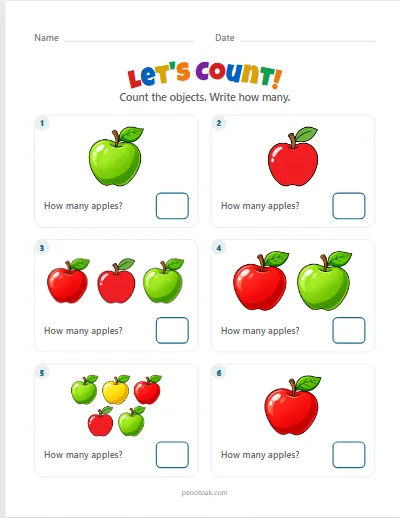
Steps 2 and 3. Count the pictures in each box and write how many. Up to 5, 10 or 20.
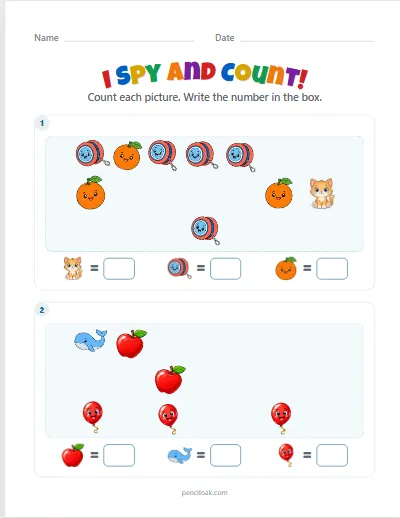
Step 2, scattered things. Count each kind of picture hiding in a scene.
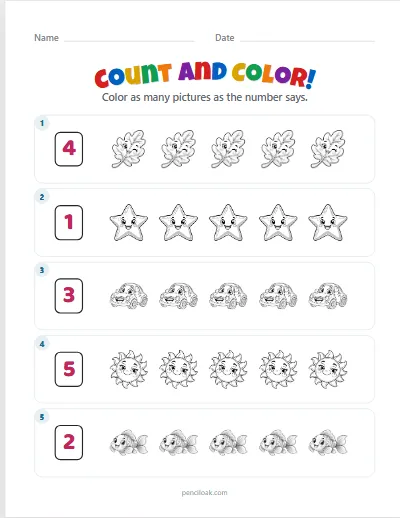
Step 4. Read the number and color exactly that many pictures.
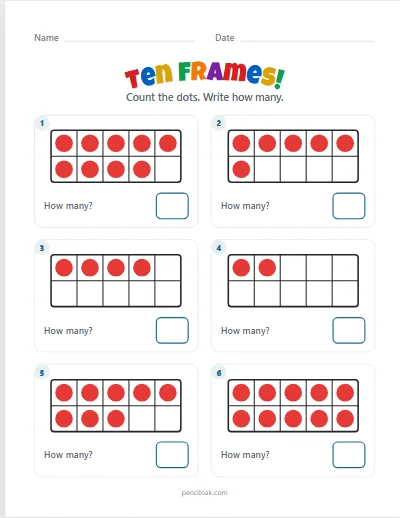
Steps 4 and 5, numbers 6 to 10. Count the dots in a ten frame and write the number.
Ready for the next step? Try addition with pictures or the number line. You can also browse all worksheets.
Read next
- Ten frames, tens and onesFill the ten frame, make ten, see a teen number as ten and some more, then count by tens and find your way on the hundred chart.
- Addition and subtraction with picturesFrom real objects to pictures, the number line and dominoes: adding, taking away and, last of all, writing the sum.
- Patterns, sorting and logic puzzlesSort, find the odd one out, continue a pattern, color the other half and solve a first sudoku — and why "how do you know?" matters most.