
Rhymes and syllables
Before a child reads, they need to hear that spoken words are made of smaller pieces. Words have parts that can be clapped (syllables), words can end with the same sound (rhymes), and every word has a first and a last sound. These are listening skills, and a child can practice them in the car, at the table or at bedtime, with no letters and no pencil at all.
This guide goes from the biggest pieces of a word to the smallest. Each step takes a few minutes, and the games are meant to be silly and fun.
This is a general routine, not an assessment. If you are worried about how a child hears or speaks, talk to their teacher or doctor.
Before you start
- No letters are needed for the first steps. Pictures of everyday things are enough: a cat, a zebra, a butterfly.
- Say words clearly and slowly, and let the child say them back.
- Sing and say nursery rhymes together. They are the easiest way to hear rhyme.
Step 1: Clap the parts of a word
Start with names. "Em-ma" has two claps. "Ben" has one. "Jo-se-phine" has three. Say each word slowly, clapping once for every part, and let the child join in. A trick many teachers use is to put a hand under the chin: the jaw drops once for each part. Then try animals and foods: "cat" is one clap, "ze-bra" is two, "but-ter-fly" is three. Sort pictures into piles of one, two and three claps.
Step 2: Hear a rhyme
Rhyming words end with the same sound: cat and hat, sun and run. Say a rhyme and leave out the last word, and let the child fill it in. Then ask yes-or-no questions: "Do cat and hat rhyme? Do cat and dog rhyme?" Silly made-up words are fine ("cat, hat, zat"). The aim is to hear that the endings match.
Step 3: Make a rhyme
When the child can hear a rhyme, ask them to make one: "Tell me a word that rhymes with cat." If they say a word that does not rhyme, say both words together and listen: "Cat, car. Do they end the same?" A child may start by giving words that begin the same, such as cat and car. That is a different game, and you can name it: "Those start the same. I am listening for words that end the same."
Step 4: Read the rhyme
Once the ear is ready, print joins in. Read a word with the child and look at three more. The one that ends the same way is the rhyme. At first, pick words that rhyme and are spelled the same at the end, like cat and hat. Words such as blue and shoe rhyme but look different, so they are better saved for later.
Step 5: Word families
A word family is a group of words that end the same way, in sound and in spelling: -at (cat, hat, mat), -an (can, man, pan), -un (sun, run, fun). Once a child can read one of them, they can read many. Read the family together, change the first letter, and ask the child to find the odd one out in a group of six words.
Step 6: Listen to the first and last sound
The smallest pieces are the single sounds. Play "What is the first sound in sun?" and then "What is the last sound?" The last sound is usually harder to hear. Connecting each sound to a letter is covered in the guide on letters and first sounds.
When it goes wrong
- Cannot hear rhymes yet. This is common at first. Sing more rhymes, exaggerate the ending, and stay with very short words.
- Gives words that start the same. Name the difference: "That one starts the same. I want one that ends the same."
- Claps the wrong number for long words. Use the hand under the chin and say the word slowly. Count the parts together.
- Says the letter name instead of the sound. Say the sound for them and ask again. Listening comes first, letters after.
- Gets frustrated. Turn it into a game, take turns, and make the mistakes silly on purpose.
Practice without a worksheet
- Clap the syllables of everyone's name at dinner.
- Play "I am thinking of a word that rhymes with..." in the car.
- Read rhyming picture books and pause before the last word of a line.
- Sort toys into piles of one, two and three claps.
- Make up silly rhyming sentences: "The cat in the hat sat on a mat."
When to move on
You can start on reading and writing words when the child can:
- clap one, two and three parts in familiar words, with few mistakes;
- tell you whether two words rhyme;
- give a word that rhymes with a short word like cat or sun;
- say the first sound and the last sound of a short word.
Free worksheets for each step
Each tool makes a new sheet whenever you press New sheet. Every sheet has an answer key for the grown-up and prints in color or black and white.
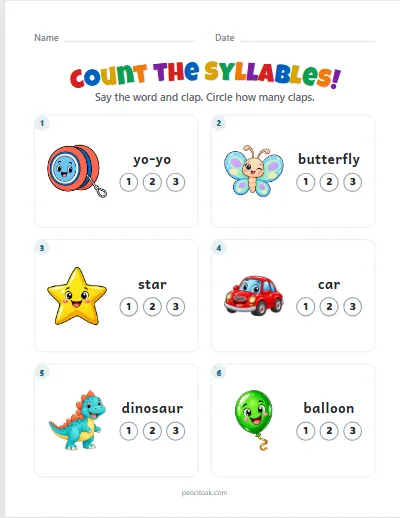
Step 1. Say the picture word, clap its parts and circle how many claps.
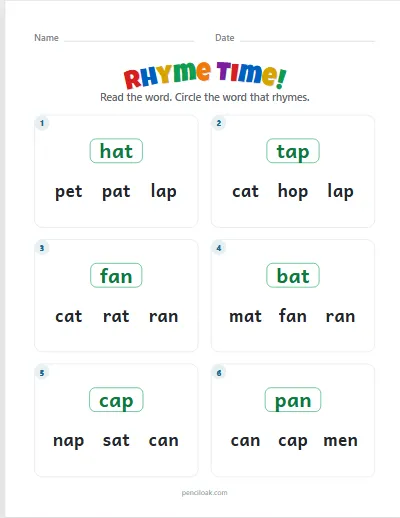
Step 4. Read a word, then circle the one of three words that rhymes with it.
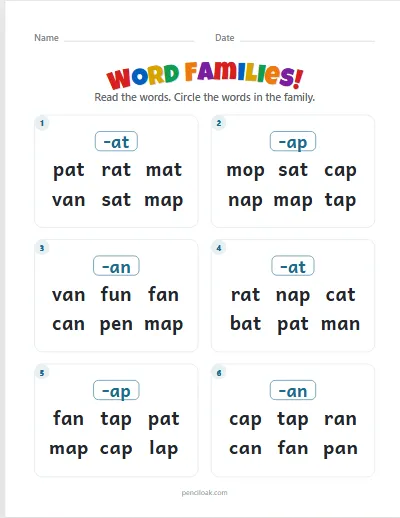
Step 5. Read six short words and circle the ones that end the same.
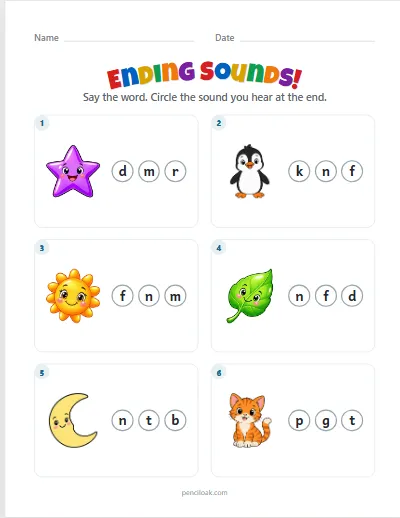
Step 6. Say the picture and circle the letter for the sound at the end.
Or teach sight words next, or browse all worksheets.
Read next
- How to teach letters and first soundsStart with their own name, match capitals to lowercase, learn a few sounds at a time, and listen for the first and last sound of a word.
- How to teach sight wordsThree to five words at a time: look, say, trace, find the word in print and read it in a sentence — and what to do when a child guesses from the first letter.
- Patterns, sorting and logic puzzlesSort, find the odd one out, continue a pattern, color the other half and solve a first sudoku — and why "how do you know?" matters most.