
How to teach sight words
Sight words are the small, common words that turn up in almost every sentence a child reads: the, and, see, look, can, go. The name comes from the goal. A child should know them at a glance, without stopping to sound them out. Some of them cannot be sounded out easily at all (the, said), and the rest are so common that reading gets slow and tiring if the child has to work out each one again.
This guide gives a simple routine for teaching them in small groups. It works with any list of common words. The Dolch word list, which the sight word sheets on this site follow, is a well-known one, and it is a good place to start.
This is a general routine, not an assessment. If you are worried about how a child is learning to read, talk to their teacher.
Before you start
- The child should know most of the letters and their sounds. If not, begin with the guide on letters and first sounds.
- Write the words you are teaching on cards, one word per card, in clear lowercase letters.
- Plan five to ten minutes a day. Reading together every day matters just as much as these drills.
Step 1: Choose three to five words
Start with a few. Good first words are the ones the child will see most: the, a, I, and, see, look, can, go. Pick words that look different from each other. Do not teach "was" and "saw" in the same week, and leave look-alikes for later. Keep the same words for several days, until the child knows them well.
Step 2: Look, say, trace
Show a card and read the word aloud. Have the child say it, point to each letter and trace the word with a finger. Then trace it on paper with a pencil, saying the word again when they finish. Let them see, say and move their hand for the same word.
Step 3: Find the word
Knowing a word on a card is different from spotting it in print. Play "find the word": ask the child to point to every "the" on a page of a book, or to circle it in a row of look-alike words. Word searches work on the same skill, with the words hidden across and down.
Step 4: Read the word in a sentence
Put the words into short sentences: "I see the cat." "Can I go?" Read the sentence yourself first, then read it together, then let the child read it alone. A word that is easy on a card can fall apart when it sits in a sentence, so this step shows what the child really knows.
Step 5: Write the word
Only when a word is easy to read, ask the child to write it: trace it on dotted lines, then copy it, then write it from memory. Writing is slow, so it takes the longest, and children often read a word long before they can spell it.
When it goes wrong
- Guesses from the first letter. The child says "this" for "the", or "they" for "then". Cover everything but the word, point to each letter in order, and read it again. Practice with look-alike words side by side.
- Reverses words. "Was" and "saw", or "on" and "no", are common mix-ups. Teach them in different weeks, and read each one in a sentence, since the meaning shows which is right.
- Knows the word on the card, not in the book. Go back to step 3 and step 4, and hunt for the word in books the child likes.
- Forgets the words. Review the old words first, every day, before adding a new one. Two or three more days on the same group often helps.
- Gets bored. Keep sessions short, change the game, and read something they love together.
Sight words without a worksheet
- Stick two or three word cards on the fridge or the bedroom door, and read them every time you pass.
- Play memory, with two cards for each word.
- Write a word with a finger in a tray of sand, flour or salt, or with chalk outside.
- Hide the cards around the room and let the child find and read them.
- Read picture books aloud together, and ask the child to read the sight words as you go.
When to move on
Add the next group of words when the child can:
- read all the words in the current group from cards in about a second each;
- find each word in a row of look-alikes;
- read a short sentence that uses them;
- trace each word and write most of them with a little help.
Free worksheets for each step
Each tool makes a new sheet whenever you press New sheet. Every sheet has an answer key for the grown-up and prints in color or black and white. The sight word tools offer a Pre-K and a Kindergarten word list.
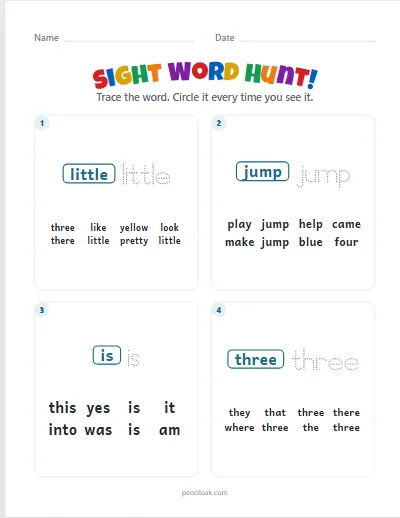
Steps 2 and 3. Trace a sight word, then find and circle it among look-alikes.
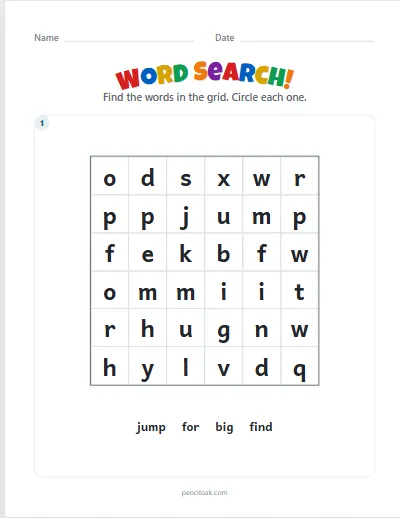
Step 3. Find sight words hidden across and down in a grid of letters.
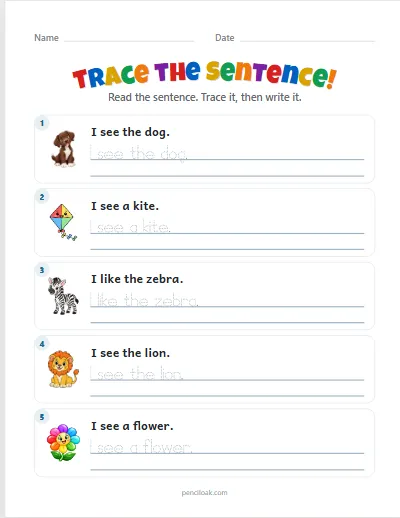
Steps 4 and 5. Read a short sentence, trace it, then write it.
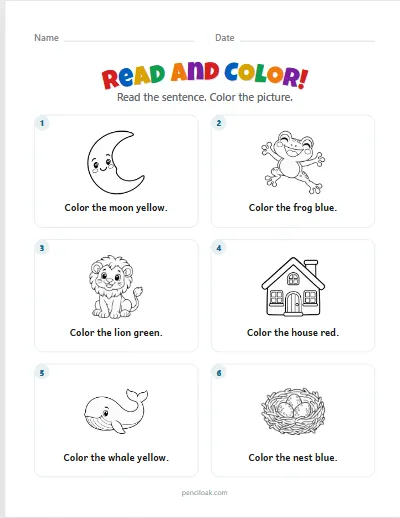
Step 4. Read a short sentence and color the picture the right color.
You can also try picture words, where the child reads three words and circles the one that names the picture, or browse all worksheets.
Read next
- Rhymes and syllablesClap the parts of a word, hear a rhyme, make one, then meet word families and the last sound — all listening games first.
- How to teach letters and first soundsStart with their own name, match capitals to lowercase, learn a few sounds at a time, and listen for the first and last sound of a word.
- Pre-writing and cutting: fine motor skillsFrom playdough and tongs to lines, shapes, pencil grip and scissors — what to practice first, and what to do when a small hand tires.