
Time, money and the calendar
Time and money are hard to see. You cannot hold a Tuesday in your hand, and a small coin can be worth more than a bigger one. That is why children learn them best through daily life: the things that happen every morning, the days they go to school, the birthday they are waiting for, the coins in a pocket. This guide starts with the words for time, moves to the days of the week and the months, then to reading a clock, and ends with naming and counting coins.
You do not have to finish one part before starting the next. Clocks, calendars and coins can all run side by side, a few minutes at a time. What matters most is talking about them every day, not only on the days you sit down with a worksheet.
This is a general routine, not an assessment. If you are worried about how a child is learning, talk to their teacher.
Before you start
- Hang a calendar where the child can reach it, and a clock with hands and all twelve numbers.
- Keep a small jar of real coins: pennies, nickels, dimes and quarters. Coins go in the mouth easily, so stay close with young children.
- For coins the child should count to 20 and, later, count by 5s and 10s. The guide on teaching counting to 10 is a good start.
Step 1: Talk about time through the day
Before clocks and calendars, children need the words. Use them as things happen: morning, afternoon, evening, night; before and after; first, next, last. "First we brush our teeth, then we read a story." "After lunch we go to the park." Ask the child to tell you the order of their day, or to put three photos or drawings of the day in order. This is the idea under every clock and every calendar: things happen one after another.
Step 2: Learn the days of the week
Say the seven days in order as a chant, every day, the same way: Monday, Tuesday, Wednesday, Thursday, Friday, Saturday, Sunday. Then connect each day to something real: "On Saturday we go to Grandma's." "Wednesday is library day." Start each morning with three questions: What day is today? What day was yesterday? What day will it be tomorrow? Point to the calendar while you answer. A week goes around in a circle, so after Sunday comes Monday again.
Step 3: Learn the months of the year
There are twelve months, and they come in the same order every year. Say them as a chant, like the days. Then find the months that matter to the child: their birthday, a holiday, the month school starts. Mark them on the calendar and count how many months are left. Turn the calendar page together at the start of each month and say the new name. After December comes January again, and a new year begins.
Step 4: Read the clock: o'clock
A clock has two hands. The short hand shows the hour, and the long hand shows the minutes. Start with times on the hour. When the long hand points straight up to the 12, it is something o'clock, and the short hand says which hour: "The short hand points to 3, so it is 3 o'clock." Say the time aloud at moments the child cares about: "It is 12 o'clock. Time for lunch." Then let them move the hands of a toy clock or a paper plate clock to show a time you say.
Step 5: Read the clock: half past
When o'clock is easy, show half past. The long hand points straight down to the 6, halfway around the clock. The short hand has moved too: it sits halfway between two numbers. Half past 3 is written 3:30, and the short hand is between the 3 and the 4. This is where most mistakes happen, so read the short hand first and say: "It has passed the 3, but it is not at the 4 yet."
Step 6: Know the coins
Lay out one of each coin and talk about them: the color, the size, the pictures. A penny is worth 1 cent, a nickel 5 cents, a dime 10 cents and a quarter 25 cents. The tricky part is that size does not tell the value: the dime is the smallest of the four coins but is worth more than the penny and the nickel. Play sorting games first: put all the pennies together, all the nickels together. Then ask the child to find a coin by name, and later by its value: "Show me the coin that is worth 10 cents."
Step 7: Count coins
Start with pennies only, because counting pennies is just counting. Then add nickels and count by 5s, then dimes and count by 10s. When the coins are mixed, put them in order from the biggest value to the smallest and count on from the first one: a dime, a nickel and two pennies are "10, 15, 16, 17 cents." Keep the totals small at first, up to 20 cents, and play shop with real coins and price tags on toys.
When it goes wrong
- Mixes up yesterday and tomorrow. Use the calendar every morning and point: yesterday is the day behind, tomorrow is the day ahead.
- Reads the long hand as the hour. Cover the long hand with a finger and read the short hand alone, then uncover it.
- Says half past 3 is "half past 4". The short hand has not reached the 4 yet. Look at which number it has just passed.
- Thinks the biggest coin is worth the most. Put a dime next to a nickel and ask which one buys more. Come back to the values often.
- Counts every coin as one. Go back to pennies only, then add one nickel and count "5, 6, 7".
Practice without a worksheet
- Start the day with the calendar: today, yesterday and tomorrow.
- Say the time on the hour whenever you look at a clock together.
- Make a paper plate clock with hands held on by a paper fastener.
- Play shop with real coins and price tags of 1 to 20 cents.
- Count down the days to a birthday or a trip by crossing them off.
When to move on
The child is ready for harder time and money questions when they can:
- use the words before, after, yesterday, today and tomorrow correctly;
- say the days of the week in order and the day after a given day;
- find their birthday month on a calendar;
- read and show a time on the hour and half past on a clock with hands;
- name the four coins, say their values, and count a few mixed coins.
Free worksheets for each step
Each tool makes a new sheet whenever you press New sheet. Every sheet has an answer key for the grown-up and prints in color or black and white. Counting by 5s and 10s helps with nickels and dimes: try skip counting.
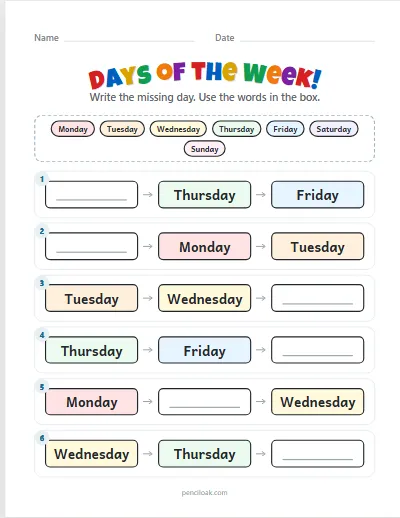
Step 2. Write the missing day in a row of days, or the day before and after.
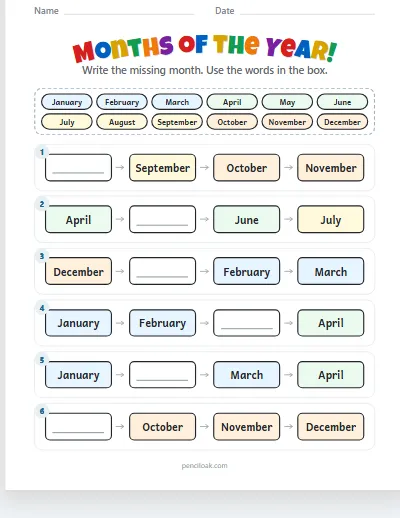
Step 3. Write the missing month in a row of months.
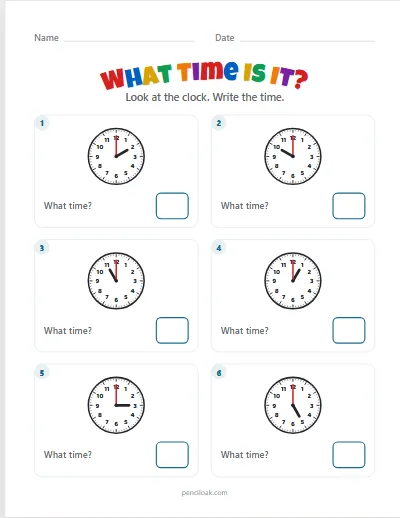
Step 4. Read the clock and write the time on the hour.
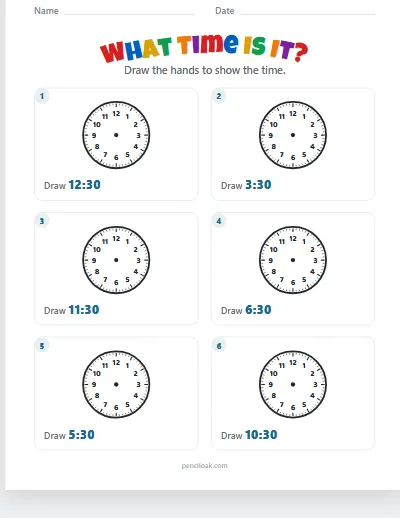
Step 5. Draw the hands to show half past.
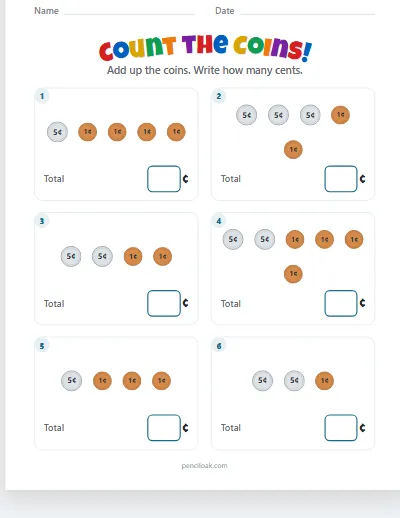
Step 7. Add up pennies and nickels and write how many cents.
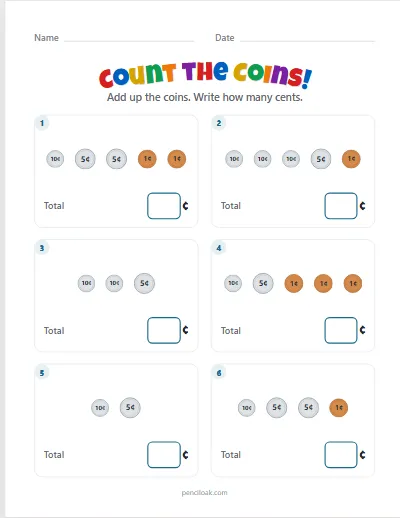
Step 7. Then add dimes: count on from the biggest coin.
Comparing and ordering also come up in shapes and measuring. You can also browse all worksheets.
Read next
- How to teach counting to 10Say the numbers, touch each thing once, know the last number says how many — one small step at a time, with free printable practice.
- Addition and subtraction with picturesFrom real objects to pictures, the number line and dominoes: adding, taking away and, last of all, writing the sum.
- Ten frames, tens and onesFill the ten frame, make ten, see a teen number as ten and some more, then count by tens and find your way on the hundred chart.